Toy Brick Color Font: Building Creativity
Finding the right visual asset for a project can often feel like searching for a missing puzzle piece. You need something that communicates a specific mood—in this case, playfulness, nostalgia, and structure—without overwhelming the message. The Toy Brick font set is designed to solve that specific design challenge. It transforms standard typography into architectural elements, mimicking the aesthetic of beloved building blocks. However, understanding how to use this asset effectively requires looking beyond the surface-level novelty. It is a tool that serves different purposes depending on who is using it and what they are trying to achieve.
Understanding the Toy Brick Aesthetic
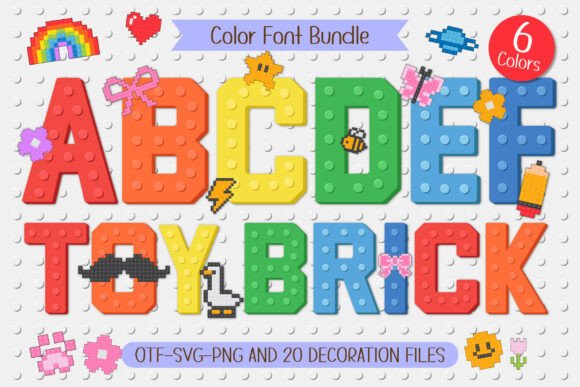
At its core, the Toy Brick font is a display typeface that relies on realistic textures and pixel-art styling. Unlike standard sans-serif or serif fonts that prioritize readability in long paragraphs, this font is built for impact. It features a distinct brick-stud texture on every character, giving the text a three-dimensional, tactile appearance. This visual weight is crucial for headers, logos, and decorative elements where the goal is to capture attention immediately.
The set includes six vibrant colors, which allows for immediate visual hierarchy without needing complex layering techniques in graphic design software. Furthermore, the inclusion of 20 matching Pixel Doodles—such as bows, flowers, and lightning bolts—provides a complete ecosystem for design. This means a creator does not have to hunt for separate graphics to match the font; the visual language is consistent. For anyone evaluating this tool, the primary benefit is cohesion. It eliminates the guesswork of pairing fonts with icons, ensuring that the "fun factor" remains consistent throughout a project.
Diverse Applications for Different Users
The value of a thematic asset like Toy Brick shifts significantly based on the user's intent. A professional designer approaches it differently than a parent making a birthday invitation or an educator creating classroom materials.
For Graphic Designers and Creatives
Experienced designers often look for fonts that offer distinct character without being illegible. While Toy Brick is whimsical, the block structure ensures that letters remain recognizable. For a designer working on a children’s book cover, a family entertainment center logo, or a retro-gaming interface, this font provides a ready-made solution. It speeds up the brainstorming phase. Instead of rendering 3D text manually, the designer can type out a headline and immediately see if the tone fits the brief.
Flexibility is also a key priority here. The color variations allow designers to match the font to existing brand palettes. If a client has a specific shade of blue for their educational app, the designer can overlay the brick texture or utilize the provided colors as a starting point for a mood board. The inclusion of the pixel doodles is particularly useful for web designers looking to create custom bullet points or dividers that maintain the theme without cluttering the interface.
Educators and Parents
For educators, the priority is rarely commercial viability; it is engagement and clarity. Classroom materials need to be visually stimulating to hold the attention of younger students. Using Toy Brick for a "Word of the Week" poster or a reading chart taps into a visual language that children already understand and love. The associations with play make the learning material feel less like a chore and more like an activity.
Parents often face the challenge of creating personalized items—such as party invitations or bedroom door signs—that look polished without requiring professional software skills. This font simplifies that process. Because the design elements are integrated into the letters, a parent using a basic word processor can achieve a professional-looking result. The ease of use is the deciding factor here; they do not need to understand kerning or leading, they simply need to type and print.
Small Business Owners and Entrepreneurs
For small business owners, specifically those in the toy industry, childcare services, or educational supplies, branding is about trust and approachability. The Toy Brick font signals that a business is child-friendly and modern. It can be used on social media graphics to announce sales or on packaging to highlight features like "Eco-Friendly" or "Non-Toxic."
However, business owners must also consider the presentation and longevity of their assets. While the font is excellent for short-term campaigns or specific product lines, it might not be suitable for the main body text of a corporate website. The practical application here is strategic: use Toy Brick for the "fun" elements (sale banners, social stickers, kids' menu headers) while pairing it with a clean, professional sans-serif for the actual details. This balance ensures the brand remains approachable but still legible and credible.
Hobbyists and Personal Projects
Scrapbookers, journal enthusiasts, and makers often prioritize creativity and uniqueness. For a hobbyist, the Toy Brick font is a way to add a mixed-media look to digital projects without the mess of actual glue and paper. It allows for the creation of personalized stickers or labels for storage bins. The "Pixel Doodles" are particularly relevant here, as they can be used as embellishments on digital planners or printed out to decorate physical gifts. The value proposition for this group is the joy of creation; the font serves as a catalyst for personal expression.
Evaluating the Asset: Practical Considerations
When deciding if Toy Brick fits a project, it is helpful to evaluate it against specific criteria such as quality, reliability, and creative scope.
- Visual Quality: The realism of the brick-stud texture is the defining feature. High-quality rendering ensures that the font does not look blurry or cheap when printed on large formats, such as banners or posters.
- Color Utility: The six provided colors are a starting point, but the ability to modify or layer them determines the font's flexibility. A good asset allows the user to adapt it to their specific color scheme.
- Thematic Consistency: The matching doodles are a significant value-add. They ensure that the visual story remains consistent, which is vital for professional branding or cohesive educational sets.
Different users will weigh these factors differently. A professional might prioritize the resolution and scalability of the texture for print, while a casual user might prioritize how easy it is to change the colors in their software.
Matching the Font to Your Goals
To determine if Toy Brick is the right choice, consider the context of your project. If you are designing a corporate annual report, the playful block aesthetic is likely inappropriate and could undermine the seriousness of the data. However, if you are launching a marketing campaign for a summer camp, a toy store, or a coding class for kids, the font immediately sets the correct expectations.
It is also worth considering the "shelf life" of the design. Trends in design come and go, but the aesthetic of building blocks is a perennial favorite because it is tied to a universal childhood experience. This gives the font a degree of reliability for recurring projects, such as annual birthday parties or seasonal school events.
Ultimately, the decision comes down to the message you want to send. If that message involves fun, construction, creativity, or childhood, Toy Brick provides a robust, visually cohesive, and ready-to-use foundation that can save time and enhance the final product. It bridges the gap between complex 3D rendering and simple typography, offering a middle ground that is accessible to beginners yet stylistically satisfying for professionals.