Tattoo Letter: Capturing the Spirit of Traditional Ink in Modern Design
The Unmistakable Voice of Old School Ink
In a digital world saturated with sleek, minimalist sans-serifs and predictable geometric fonts, there exists a powerful counter-current: the desire for authenticity, history, and character. This is the domain of Tattoo Letter, an old school tattoo font that doesn't just spell words—it tells a story. It’s a typeface that carries the weight of tradition, the grit of the workshop, and the timeless allure of classic American tattoo flash art. More than just a collection of glyphs, Tattoo Letter is a visual language that communicates rebellion, craftsmanship, and an unapologetic sense of self.
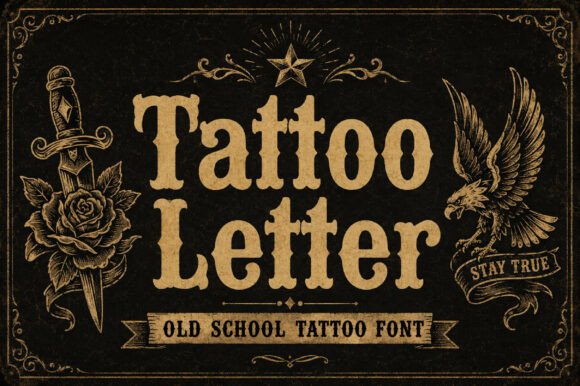
At its core, Tattoo Letter is a direct homage to the lettering styles that defined the golden age of tattooing. Its design is intentionally heavy and ornamental, built for maximum impact and vintage authenticity. Each letterform is characterized by classic western serifs—the sturdy, decorative strokes at the ends of letters that provide a sense of stability and old-world elegance. These are not delicate, refined serifs; they are bold, confident, and unyielding, much like the artists who first etched them into skin.
Anatomy of an Authentic Typeface
What truly sets Tattoo Letter apart from generic "tattoo-style" fonts are its nuanced details. Observe the rhythmic dots and subtle imperfections integrated into its design. These are not flaws; they are deliberate features that mimic the natural bleed of ink on skin, the texture of aged flash sheets, and the hand-crafted quality of vintage signage. This weathered texture is crucial. It prevents the font from looking digitally sterile, instead giving it a tangible, almost tactile quality. The result is a typeface that feels lived-in and legendary before it's even applied to a project.
The visual weight of Tattoo Letter is its superpower. It commands attention without shouting. This robust presence makes it an exceptional choice for applications where a brand or message needs to stand out with conviction and personality. It’s a font that doesn’t whisper; it makes a statement. This inherent "stay true grit" is balanced by an underlying professional artisanal grace. It’s not chaotic or illegible; it’s carefully crafted to be both visually striking and functionally readable, ensuring your message is delivered with unforgettable clarity.
Practical Applications: Where Grit Meets Grace
Understanding the essence of Tattoo Letter is one thing; knowing where to deploy it is another. Its unique character makes it unsuitable for body text or lengthy paragraphs, but it shines brilliantly in specific, high-impact roles. Consider these real-world scenarios where this font can elevate a project from ordinary to legendary:
- Streetwear & Apparel Branding: For brands rooted in counterculture, skateboarding, or vintage Americana, Tattoo Letter is a perfect match. It can be used for logo lockups, bold front prints on t-shirts, or custom patches on denim jackets, instantly conveying an authentic, rebellious ethos.
- Craft Brewery & Distillery Labels: In a market that values heritage and handcrafted quality, this font speaks volumes. Imagine it on a bottle label for an IPA or a bourbon, suggesting a recipe with history and a brand with soul. It pairs beautifully with illustrated labels featuring anchors, eagles, or botanical motifs.
- Custom Motorcycle & Automotive Graphics: The world of custom bikes and hot rods is steeped in tradition and personal expression. Tattoo Letter is ideal for shop logos, event posters, or custom graphics on fuel tanks and helmets, echoing the hand-painted pinstriping and lettering of the culture.
- Editorial Headers & Magazine Design: Use it to create powerful, attention-grabbing headlines for articles about music, art, history, or subculture. A headline set in Tattoo Letter can set the entire tone for a feature story, promising content with depth and character.
- Event Posters & Album Art: For music festivals, tattoo conventions, or independent film promotions, this font provides instant visual shorthand for an event that is edgy, authentic, and not for the faint of heart.
Evaluating Suitability: A Guide for Creators and Professionals
While Tattoo Letter is incredibly powerful, its effectiveness depends on context. It’s a specialist tool, not a general-purpose workhorse. Here’s a practical framework for deciding if it’s the right choice for your project:
- Audience Alignment: Does your target audience appreciate or identify with themes of tradition, rebellion, craftsmanship, or vintage Americana? If your brand is corporate, minimalist, or aimed at a highly formal market, this font may create a disconnect.
- Project Scope: Is it being used for a headline, a logo, or a short, impactful phrase? Avoid using it for long descriptions, user interface elements, or anything requiring sustained, easy reading. Its strength is in short bursts of high character.
- Design Harmony: Tattoo Letter works best when it has room to breathe. Pair it with simpler, cleaner secondary fonts for body copy to create a balanced hierarchy. Let it be the star of the show, supported by a subtle cast.
- Authenticity vs. Cliché: Are you using it to genuinely connect with the culture it represents, or merely as a superficial style? Audiences are adept at sensing authenticity. Integrate it thoughtfully with other design elements that share a similar ethos to avoid a generic or "clip art" feel.
For a graphic designer creating a poster for a local blues bar, Tattoo Letter could be the perfect choice for the band name. For a tech startup’s app interface, it would likely be inappropriate. The key is to match the font’s inherent personality with the message and context of the project.
Beyond the Font: Building a Visual Identity
Using Tattoo Letter effectively often means thinking beyond the letters themselves. Its style invites complementary design choices. Consider incorporating vintage textures like distressed paper or worn leather backgrounds. Use a color palette drawn from classic tattoo art: bold reds, navy blues, blacks, and creamy yellows. Pair it with illustrative elements that share its hand-drawn quality—perhaps a traditional rose, a swallow, or a banner.
This approach transforms the font from a mere typographic element into the cornerstone of a cohesive visual identity. It ensures that the "stay true grit and professional artisanal grace" promised by Tattoo Letter